Psychoanalysis and analytical psychology, read for one purpose: to find
what a person keeps out of view, and why the keeping costs so much.
The depth schools share one wager. Much of what moves us is not available
to introspection, and it is not inert. It pushes, it disguises itself, and it returns in
symptoms, slips, dreams and the people we cannot stand.
They disagree about almost everything else. This room sets out the working concepts a
shadow practice needs, with a label on each. Some have research behind them. Some are
clinical tradition. Some are maps of meaning that make no empirical claim at all.
Sigmund Freud, 1856 to 1939
The dynamic unconscious
The unconscious as a force Clinical
Freud's unconscious is not a storeroom but a pressure. Wishes and memories kept from
awareness stay active and seek a way out. That modern cognitive science finds much
processing unconscious is established. That it is organised by repressed wishes is not.
Repression Clinical
The motivated forgetting of what would cause pain or shame. Contested: laboratory work
on suppression exists, but repressed and recovered memory of trauma remains one of the
most disputed claims in the field.
Repetition compulsion Clinical
The tendency to restage an old injury with new people, as if the outcome might change
this time. The same kind of partner, the same kind of boss, the same quarrel in a new
kitchen. Freud set it out in Beyond the Pleasure Principle (1920).
Transference Clinical
Feelings and expectations from early relationships carried onto a present one, first
noticed with the analyst. Outside the consulting room it explains why a stranger can
feel instantly like a parent, and why we answer them as one.
Anna Freud, 1936, and after
The defences Evidence
Defences are the ways the mind keeps a painful feeling or fact at a
distance. They are ordinary and often useful. Trouble starts when one becomes the only
move available.
Defence
What it does
An everyday example
Projection
Places one's own trait or impulse in another
The person who is quietly envious sees envy in everyone around them.
Denial
Refuses a fact that is plainly present
Not opening the bank statements for six months.
Reaction formation
Turns a feeling into its loud opposite
Exaggerated warmth towards a colleague one resents.
Displacement
Moves a feeling to a safer target
Angry at the manager, sharp with the partner at dinner.
Rationalisation
Supplies a good reason for a real one
"I didn't want that job anyway" after the rejection.
Intellectualisation
Converts feeling into analysis
Discussing a diagnosis in statistics, never in fear.
Splitting
Sorts people into all good or all bad
A friend is perfect until one slight, then worthless.
Sublimation
Routes an impulse into valued work
Aggression spent in the boxing gym or the trial courtroom.
Vaillant's longitudinal work arranged defences
from immature to mature and linked the mature ones to better outcomes over decades. Cramer
developed measures that let defences be studied in the laboratory. The construct holds up;
individual case readings remain interpretation.
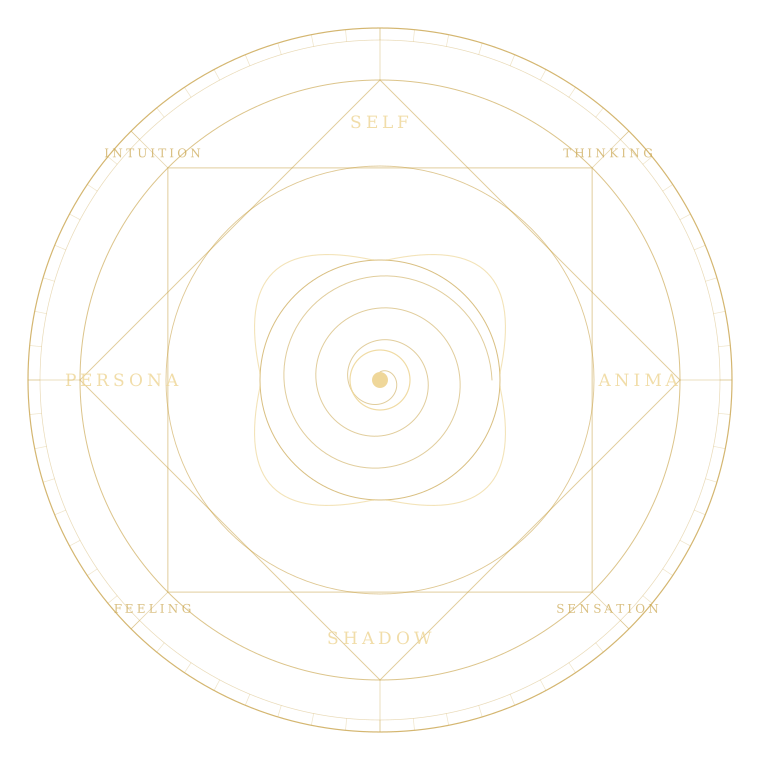
The quaternity, drawn for Room I and borrowed here
Carl Gustav Jung, 1875 to 1961
The shadow
The personal shadow is what a person has refused to be: the traits their family,
class or self-image could not hold. The collective shadow is what a group refuses,
and it is usually found in a scapegoat. Symbolic
Projection is the shadow's main road. We meet it first outside, in the person who
provokes a charge out of proportion to what they did. The size of the reaction is the
clue, not the content of the complaint.
The full figures of the psyche, persona, anima, animus and the Self,
are in Room I, the Archetypes.
The golden shadow Craft
Disowned gifts go into the shadow too. Admiration that feels slightly painful often
marks a capacity one was told was not for people like us. The term comes from the
Jungian practice literature, not from Jung himself.
Active imagination Craft
Hold an image from a dream or mood, let it move on its own, then speak to it. The ego
keeps its own standpoint and answers back. A method of encounter, with no trial evidence
either way.
Individuation Symbolic
Jung's name for becoming the whole of what one is, not a better persona. It is a
direction, not a destination, and it starts with the shadow because that is where the
missing material lies.
Object relations and after
Klein, Winnicott, Lacan
Klein: splitting and the two positions Clinical
In the paranoid-schizoid position the world is split into the good object and the
persecutor. In the depressive position one bears that the loved and the hated are the
same person. The second brings guilt, and with it the wish to repair.
Winnicott: true self, false self Clinical
A child who must comply too early builds a false self that manages the world and
protects a true self that never gets to live. The good-enough mother fails in
bearable doses, and so lets the child become real.
Lacan: the mirror stage Symbolic
The infant greets its unified image in the mirror while its body still feels in
pieces. The ego, on this reading, is founded on an image from outside: a coherence
borrowed, and defended ever after.
Lacan: the desire of the Other Symbolic
We desire what others desire, and we desire to be desired by them. Shadow work asks
a Lacanian question here: whose wanting is this? Lacan's claims are theoretical and
largely untestable as stated.
Evidence status
What holds, and what is still a map
Evidence Psychodynamic psychotherapy has trial support.
Shedler's 2010 review in American Psychologist reported effect sizes comparable to
other established therapies, with gains that tended to continue after treatment ended.
Evidence Defence mechanisms are measurable, and maturity of
defence predicts adjustment, in the work of Vaillant and Cramer.
Symbolic Many specific theoretical claims are not
empirically established: the Oedipus complex as universal, archetypes as inherited
structures, the death drive. Use them as lenses, not as findings.
This room is study, not treatment. If old material surfaces with
force, work with a qualified clinician rather than alone.
What a person will not look at in themselves arrives from outside, as fate or
as an enemy.
A paraphrase of a recurring theme in Jung's writing